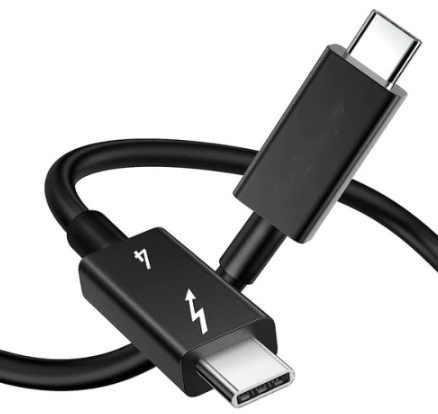
Thunderbolt 5 technology has officially entered the commercial phase, bringing substantial advancements in bus bandwidth, power delivery standards, and multi-protocol compatibility to enterprise IT infrastructure. Built on the USB-C physical interface and USB4 specifications, this standard breaks the data throughput bottlenecks of previous single-cable routes while maintaining the universality essential for IT asset management. This article deeply analyzes the core technical indicators of Thunderbolt 5, aiming to provide objective decision-making basis for hardware procurement and IT system architects, ensuring enterprises can accurately match high-load business demands and implement forward-looking asset deployment when planning next-generation endpoint devices.
Thunderbolt 5 Physical Specifications and Core Technical Indicators
Evaluating the business value of Thunderbolt 5 devices (such as Type-C docking stations and high-speed cables) requires focusing on the following specific hardware parameter iterations:

Asymmetric Bandwidth Boost: The base bidirectional bandwidth increases to 80Gbps (double that of Thunderbolt 4). Under video-intensive workloads, the controller can dynamically reallocate data lanes, providing up to 120Gbps of unidirectional video transmission speed.
Extreme Display Arrays: Supports driving two 8K@60Hz ultra-clear displays or three 4K@144Hz high-refresh-rate displays simultaneously, natively adapting to the DisplayPort 2.1 protocol.
EPR (Extended Power Range): A single cable supports up to 240W of power output. This standard meets the full-load operational requirements of high-performance mobile workstations and peripheral devices, thereby eliminating the need for redundant dedicated power adapters.
PCIe 4.0 Data Throughput: The minimum host-side PCIe link bandwidth is raised to 64Gbps. External NVMe storage clusters or GPU expansion modules can leverage this to unleash native read/write performance approaching that of motherboard built-in buses.
Backward Protocol Compatibility: Seamlessly compatible with Thunderbolt 4, Thunderbolt 3, and USB4 standards.
Strategic Logic for Enterprise-Level IT Deployment
The core value of deploying Thunderbolt 5 in an enterprise lies in establishing a highly deterministic performance margin. The combination of higher data throughput, stronger power delivery, and broad underlying protocol support allows IT departments to implement device iterations without destructive restructuring of existing systems and workflows. For organizations heavily reliant on local computing power and multi-endpoint collaboration, Thunderbolt 5 ensures the full release of new endpoint performance while maintaining a stable handshake with legacy peripheral assets.
Compatibility is the core prerequisite for standardization implementation. Thunderbolt 5 deeply integrates and strictly conforms to the latest USB4 specifications, allowing enterprises to adopt a progressive, smooth transition strategy. The unification of interface and cable protocols significantly reduces the variety of cable SKUs in IT procurement catalogs, lowering lifecycle maintenance and troubleshooting costs. A single compliant cable can fully manage power delivery, audio/video streams, and massive data interactions.
Workstation Scenario Efficacy Restructuring
Deploying underlying hardware integrated with Thunderbolt 5 interfaces provides standardized connection topologies for different functional matrices. By encapsulating specifications such as PCIe 4.0 and DisplayPort 2.1, it grants commercial mobile terminals expansion potential comparable to desktop workstations:
Audio/Video Creators and Engineering Rendering: The 120Gbps video bandwidth margin and 64Gbps PCIe lanes ensure that frame drops and link blockages are avoided when multiple 8K monitors and external disk arrays work collaboratively.
Software Development and Data Analysis: Supports multi-screen, high-resolution code review environments and high-speed concurrent data read/write for external compilation modules.
General Commercial Productivity: Ensures the lifecycle of current Type-C docking station solutions is extended, enabling plug-and-play functionality for workstation devices.
Mobile Conferences and Executive Briefings: Quickly connects to complex high-resolution casting and central control systems in meeting rooms via a single high-specification interface.
Cable Standardization in IT Infrastructure
Establishing a single physical connection standard with redundant performance can significantly optimize the initial device deployment process and compress the operational troubleshooting time spent by IT personnel on interface adaptation and protocol conflicts. As future business expansion leads to changes in endpoint requirements, a highly unified expansion dock and cable system will directly translate into business agility. Adopting next-generation connectors that support both Thunderbolt 5 and USB4 protocols outputs highly consistent end-to-end performance, evades the "wooden barrel effect" of link bottlenecks, and ensures various terminals stably exert their intended efficacy in complex enterprise deployment environments.
雷电 5 (Thunderbolt 5) 技术已正式步入商用阶段,为企业 IT 基础设施带来了总线带宽、供电标准与多协议兼容性的实质性跨越。建立在 USB-C 物理接口与 USB4 规范基础之上,该标准突破了以往单路线缆的数据吞吐瓶颈,同时维持了 IT 资产管理所必需的通用性。本文深度剖析 Thunderbolt 5 的核心技术指标,旨在为硬件采购与 IT 系统架构师提供客观决策依据,确保企业在规划下一代终端设备时,能准确匹配高负载业务需求并实现资产的前瞻性布局。