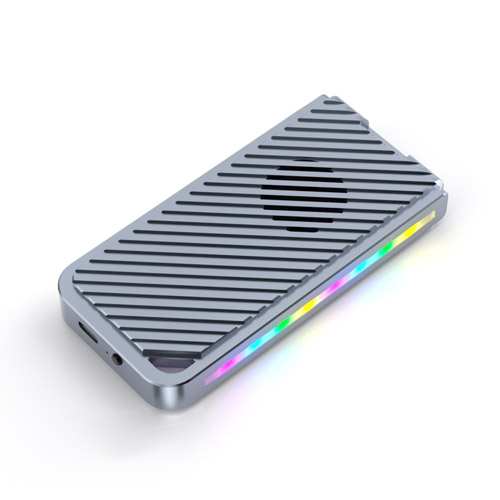
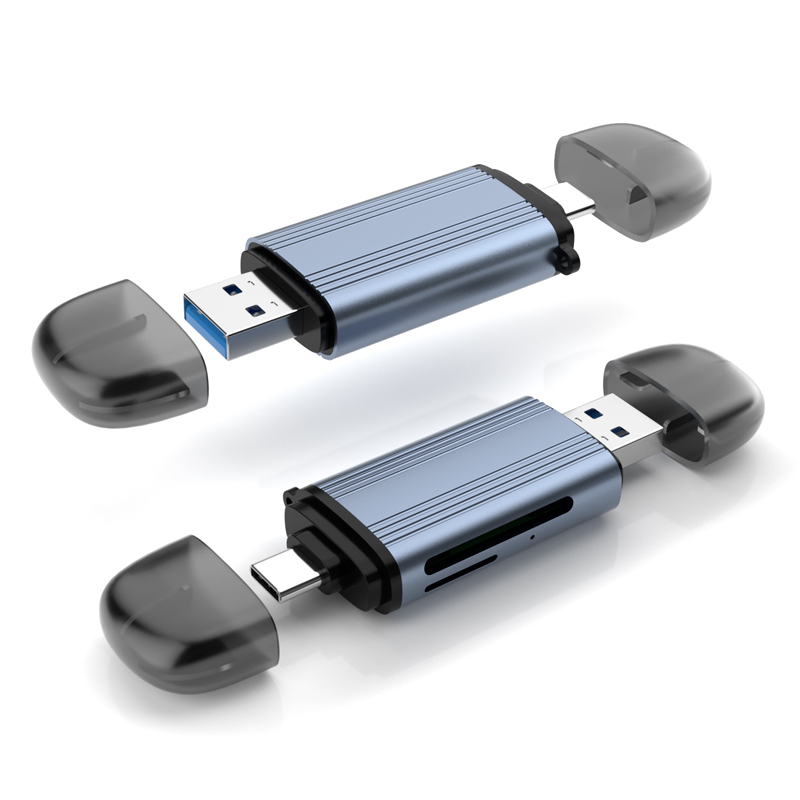
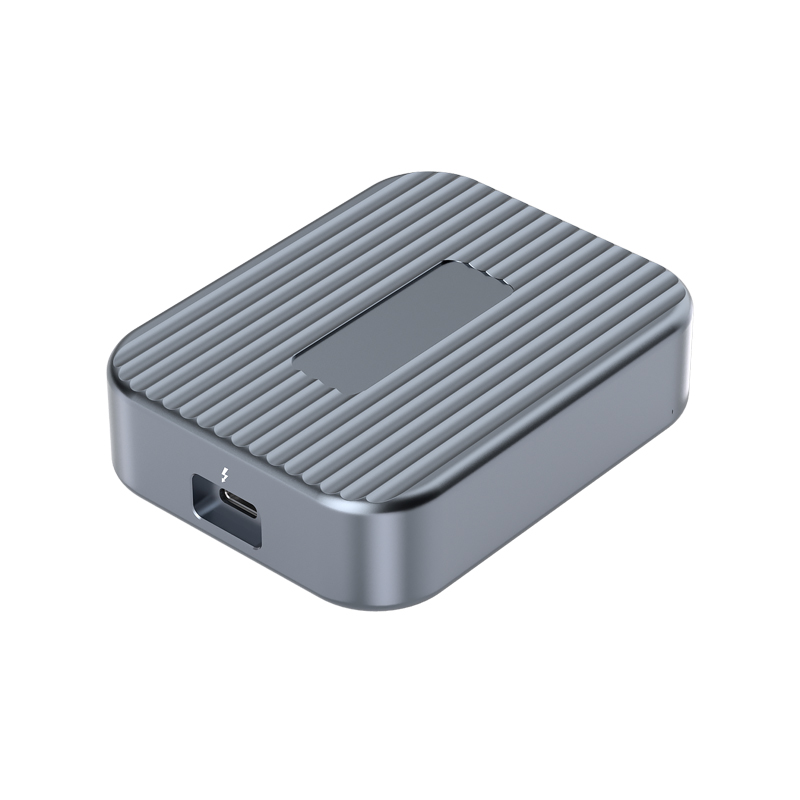
In the current landscape of ultrabook design, professionals often face a binary choice between portability and functionality. The reduction of physical ports has forced users to clutter their desks with two distinct categories of peripherals: a docking station for port replication and an ssd enclosure for external data storage.
However, with the maturation of USB 3.2 Gen 2 protocols and controller efficiency, a new hybrid category has emerged: the docking ssd enclosure. This article analyzes the technical architecture of this 2-in-1 solution, using the CM073M3 as a case study to explore how integrating storage into a hub fundamentally changes mobile workflow dynamics.

1. The Engineering Logic: Integration over Addition
A standard hub simply expands I/O avenues, while a standalone enclosure solely manages NAND flash memory. The docking ssd enclosure represents a more complex engineering challenge: managing high-bandwidth data, video signals, and power delivery simultaneously through a single USB-C uplink.
The CM073M3 addresses this by leveraging the USB 3.2 Gen 2 bus bandwidth. Unlike legacy USB 3.0 hubs that bottleneck at 5Gbps, this device is engineered to handle the concurrent demands of reading from an NVMe drive while driving external peripherals, without the latency penalties often associated with daisy-chained setups.
2. Throughput Analysis: The 10Gbps Standard
When evaluating a device that claims to be both a dock and a drive, transmission speed is the primary metric.
The CM073M3 utilizes the RTL9210 bridge controller for its M.2 slot, working in tandem with the GL3590 hub controller. This configuration establishes a hard baseline of 10Gbps.
Storage Performance: For video editors or IT professionals running Windows To Go, the internal M.2 slot bypasses the limits of SATA, offering NVMe speeds essential for real-time 4K rendering.
Peripheral Connectivity: The device exposes USB 3.2 Gen 2 Type-A and Type-C ports. Crucially, these ports also support 10Gbps. This means that transferring footage from an external SD card to the internal SSD via the docking station interface minimizes the bottleneck usually found in lower-tier hubs.
3. Visual and Auditory Fidelity: DP 1.4 and 4K 60Hz
A common compromise in compact docks is video refresh rate, often capped at 30Hz for 4K resolutions. This results in noticeable input lag, rendering the setup unusable for precision design work.
The CM073M3 integrates the GSV2201S video processing chip, which supports DP Alt Mode 1.4. When connected to a host device that supports this protocol (such as modern MacBooks or Surface Pros), the HDMI port outputs a true 4K (4096x2160) @ 60Hz signal. This ensures fluid cursor movement and accurate frame playback.

Additionally, the inclusion of a 3.5mm audio jack (powered by the GPD8104B chip) restores analog audio input/output, a feature frequently omitted in modern laptop chassis.
4. Power Delivery and Network Stability
Power management in a docking ssd enclosure is critical. The device must power the internal high-speed SSD, the ethernet controller, and USB peripherals, all while passing charge through to the host laptop.
The specification lists PD 3.0 support with a maximum input of 100W. The internal circuitry utilizes a dynamic power allocation strategy, reserving necessary wattage for the dock’s operations (ensuring the SSD doesn't disconnect during heavy loads) and delivering up to 90W to the host.
Furthermore, the RTL8153B Gigabit Ethernet controller provides a hardwired network connection. In enterprise environments where Wi-Fi congestion is prevalent, a physical RJ45 port remains the gold standard for stability and security.
5. Technical Considerations for Deployment
For users planning to integrate a docking ssd enclosure into their setup, consider the following technical constraints:
1. Thermal Management: NVMe drives generate significant heat under load. The CM073M3 utilizes an aluminum alloy chassis (11356.518.6mm) to act as a passive heat sink. Proper ventilation is required to prevent thermal throttling of the controller.
2. Host Compatibility: Video output capabilities are host-dependent. Verify that your laptop’s USB-C port supports DisplayPort Alternate Mode (DP 1.4) to achieve the full 4K 60Hz resolution.
3. Data Integrity: Unlike a simple hub, this device contains a file system. Always perform a "Safe Eject" in the operating system before disconnecting the hardware to prevent data corruption on the mounted volume.
Conclusion
The CM073M3 illustrates the shift toward high-density peripheral design. It is not merely a docking station with an added slot; it is a decentralized data center for the mobile professional. By consolidating high-speed storage and port expansion into a single docking ssd enclosure, users can streamline their hardware footprint without sacrificing the performance required for technical workflows.