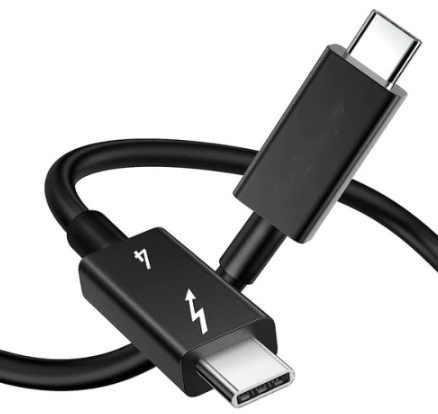
The standardization of enterprise IT infrastructure is facing a crisis triggered by connectors. Behind the physically identical USB Type-C port lies a spectrum of vastly different protocol specifications and security risks. When managing hardware refreshes across hundreds of workstations, a procurement list full of "full-featured Type-C" devices is often the beginning of a disaster. To definitively eliminate the risks of blank screens, network dropouts, and even corporate data breaches, IT decision-makers must re-examine the technical divide between Thunderbolt and USB4 at the architectural level.

This guide approaches the subject from a systems architect's perspective, offering an in-depth breakdown of these two high-speed interface protocols to provide enterprise readers of purplelec.com with precise deployment guidance.
I. The Underlying Logic of Standard Evolution: From Convergence to Bandwidth Leap
Protocol evolution is not simply a matter of doubling speeds — it represents a fundamental reconstruction of underlying logic. Intel and USB-IF (the USB standards body) have taken divergent paths in this battle for interface unification.
Looking back, Thunderbolt 3 (TB3) was the first to adopt the Type-C physical connector and established a theoretical ceiling of 40 Gbps. However, TB3 ran into painful compatibility fragmentation during market adoption. In response, Intel introduced Thunderbolt 4 (TB4) — whose core innovation was not raising peak bandwidth (still 40 Gbps), but raising the floor. TB4 converted all previously optional TB3 features into mandatory requirements, such as mandatory support for dual 4K displays and mandatory VT-d-based security protection.
At nearly the same time, Intel donated the TB3 protocol royalty-free to USB-IF, which directly gave rise to the USB4 Version 1 standard. USB4 carries Thunderbolt's DNA at its core, but to accommodate the vast and cost-sensitive peripheral ecosystem, USB-IF made many of USB4's advanced features optional — resulting in a market split between 20 Gbps and 40 Gbps USB4 variants.

Evolution continued. Both Thunderbolt 5 (TB5) and USB4 Version 2.0 introduced PAM3 (Pulse Amplitude Modulation) signaling technology, boosting bidirectional bandwidth to 80 Gbps. More disruptively, TB5 can dynamically switch to an asymmetric mode when video transmission demands spike, delivering up to 120 Gbps of unidirectional transmit bandwidth.
II. Architectural Feature Comparison
The differences on paper directly determine the stability baseline for enterprise-grade deployments. Below is a rigorous comparison of core specifications:
| Technical Dimension | Thunderbolt 4 | USB4 (Version 1 / 40 Gbps) | Thunderbolt 5 | USB4 Version 2.0 |
| Peak Bidirectional Bandwidth | 40 Gbps | 20 Gbps or 40 Gbps | 80 Gbps (up to 120 Gbps asymmetric) | 80 Gbps (up to 120 Gbps asymmetric) |
| Minimum PCIe Data Bandwidth | 32 Gbps (mandatory) | No mandatory floor (some products at 16 Gbps or unsupported) | 64 Gbps (mandatory) | PCIe support mandatory; specifics implementation-dependent |
| Minimum Display Support | Dual 4K @ 60Hz or single 8K | Single display (no hard resolution requirement) | Dual 6K | No strict high-end mandatory requirement |
| DMA Attack Protection | Mandatory (IOMMU/VT-d) | Optional | Mandatory | Optional |
| Certification Model | Strict Intel mandatory certification (higher cost) | Manufacturer self-declaration and testing (lower cost) | Strict Intel mandatory certification | Manufacturer self-declaration and testing |
Analyzing the table closely reveals that the core difference between Thunderbolt 4 and USB4 in enterprise deployment comes down to determinism. When planning large-scale workstation expansion, procuring Thunderbolt-certified devices guarantees dual 4K display support, high-speed data transfer, and baseline security protection. By contrast, purchasing devices that merely claim USB4 compliance leaves Thunderbolt compatibility as an unknown — they may fail to fully drive enterprise-grade peripherals.
III. The Enterprise Significance of PCIe Tunneling: Breaking Physical Boundaries
Traditional USB protocol is fundamentally a host-to-device command packet transport architecture. PCIe Tunneling, by contrast, extends the PCIe bus from the motherboard directly outside the chassis.
This architectural-level direct connection unlocks significant productivity gains in real enterprise scenarios:
External GPU (eGPU) Acceleration For AI algorithm teams or industrial design (CAD/BIM) departments, there is no need to provision heavy graphics workstations for every engineer. A thin-and-light laptop connected to an eGPU enclosure via PCIe tunnel can deliver desktop-class CUDA compute performance. TB4's mandatory 32 Gbps PCIe bandwidth effectively alleviates the data bottleneck during GPU rendering workloads.
Ultra-High-Speed External NVMe Storage Film and video DITs (Digital Imaging Technicians) or big data analysts regularly need to transfer terabytes of raw footage. NVMe enclosures based on PCIe tunneling can deliver real-world read/write speeds approaching 3,000 MB/s, effectively eliminating the speed gap between internal and external storage.
High-Throughput Data Acquisition In semiconductor testing or medical imaging equipment, high-speed capture cards can write raw data streams directly into system memory via the low-level interface, achieving extremely low latency.
IV. The Security Perimeter: DMA Attack Protection and Enterprise Configuration Policy
In a cybersecurity defense architecture, external ports are often the most overlooked Achilles' heel. DMA attack protection is a core metric that high-security enterprises must evaluate.
DMA (Direct Memory Access) allows hardware peripherals to read from system RAM directly, bypassing the CPU. PCIe tunneling inherently carries this elevated privilege. An attacker needs only to plug a malicious device disguised as a network card or USB drive into an unprotected port — and, entirely beneath the detection horizon of OS-level antivirus software, can instantly extract BitLocker encryption keys, enterprise VPN credentials, or executive login passwords from memory.
To close this threat vector, Thunderbolt 4 mandates that host systems enable IOMMU (Input/Output Memory Management Unit) protection based on Intel VT-d or AMD-Vi. The defense logic works by allocating each peripheral device an isolated "memory sandbox." When a peripheral attempts to access unauthorized regions of system memory, the IOMMU hardware mechanism blocks it outright.
When enforcing enterprise configuration policy, IT administrators should use domain Group Policy Objects (GPOs) or a Unified Endpoint Management (UEM) system to:
Mandatorily enable Kernel DMA Protection at the BIOS/UEFI level
Set policies to prevent enumeration of new external devices while the system is in a locked screen state
V. Bandwidth Allocation in Multi-Display and Workstation Expansion Scenarios
40 Gbps may appear generous, but in a fully loaded workstation environment it can be exhausted quickly. The protocol stack enforces a strict bandwidth priority order: DisplayPort (DP) video signals always hold the highest right-of-way, with remaining bandwidth distributed to PCIe data and USB data.

Precise data is essential for bandwidth planning. A standard 4K display (3840×2160 @ 60 Hz, 8-bit color depth) consumes approximately 12 Gbps of uncompressed video bandwidth. When a financial analyst or developer has a dual 4K display workstation setup, video streams alone will claim nearly 24 Gbps. The theoretical data bandwidth left in the cable for an external NVMe drive or gigabit network adapter is only approximately 16 Gbps — translating to a real-world application-layer throughput of roughly 1.2 GB/s to 1.5 GB/s.
With the introduction of the DisplayPort 2.1 UHBR10 specification, next-generation high-resolution displays — such as single 8K panels or high-refresh-rate monitors — will impose even more severe bandwidth demands. This is precisely the underlying driver compelling enterprises to migrate toward the 80 Gbps and 120 Gbps protocol tiers.
VI. Enterprise Thunderbolt Dock Selection Criteria
Procuring docking stations for hundreds or thousands of workstations is far more than a simple exercise in counting ports. Thunderbolt Dock selection has a direct impact on IT help desk ticket volume and device lifecycle cost.
Power Delivery (PD) Capability — The First Gate For mobile workstations equipped with high-performance processors (such as Intel H-series), the dock must sustain a stable output of 90W to 100W. Insufficient power delivery causes the laptop to throttle during code compilation or rendering, significantly degrading productivity.
Downstream Port Topology A well-designed dock typically provides three or more high-speed downstream ports in a tree topology, allowing users to branch high-speed drives and daisy-chained displays independently — rather than forcing all devices to compete for a single shared bus, as le-gacy hubs do.
Network Management Features Enterprise-class docks must include a wired Ethernet port supporting MAC Address Pass-Through and vPro remote out-of-band Wake-on-LAN. These capabilities are foundational prerequisites for IT departments to perform automated asset inventory and deploy silent overnight system patches.
VII. Compatibility Matrix and Procurement Risk Warnings
At the procurement execution stage, BOM tables and specification sheets provided by the supply chain are frequently filled with linguistic ambiguity. As architects, it is essential to issue clear professional warnings about the following labeling pitfalls:
A cable or dock bearing the label "USB4 40G" is not equivalent to having passed the most rigorous underlying protocol validation. The market is flooded with peripheral products built on low-cost controller solutions — physically equipped with a Type-C connector and marketed at 40 Gbps speeds — that have had their core tunneling controllers stripped out, rendering them incapable of recognizing any eGPU or external storage array. Even more problematic, some low-end products only support MST (Multi-Stream Transport) mirror mode during multi-display expansion, and cannot independently drive two separate extended screens.
The way to avoid these compatibility pitfalls is straightforward: enterprise IT procurement lists should be strictly anchored to products carrying official certification marks. The initial hardware cost may be marginally higher, but compared to the ongoing engineering time consumed by compatibility troubleshooting — and the hidden costs of employee downtime — a standardized, high-determinism architecture is the most cost-effective long-term investment.